
If you own waterfront property in South Florida, you already know your seawall works around the clock, standing between your home and the constant push and pull of tidal water, storm surge, and shoreline erosion. But when a seawall starts showing signs of trouble, cracks running through the panels, soil washing out from behind the wall, or sections starting to bow outward, the first question almost every property owner asks is: How much is the seawall repair in Florida going to cost?
The honest answer is that seawall repair costs in Florida vary considerably, and anyone who gives you a firm number without seeing your property is guessing. That said, understanding the factors that drive pricing of seawall repair in Florida gives you a real advantage when budgeting, comparing contractor quotes, and deciding whether to repair now or wait.
At Sea Me Dive, we’ve inspected and repaired hundreds of seawalls across Dade, Broward, and Palm Beach County. Below, we break down the 8 key cost factors we look at on every seawall repair job, along with real pricing benchmarks so you’re not going in blind.
What Does Seawall Repair Actually Cost? A Starting Point
Before getting into the seawall repair factors themselves, it helps to have some real numbers to anchor the conversation.
Most residential seawall repair projects in South Florida fall somewhere in the $15,000 to $60,000 range total. Contractors typically price standard repair work at $100 to $250 per linear foot. When the damage is more serious, meaning structural failures, extensive bowing, or sections that are beyond patching, costs can reach $300 to $600 per linear foot or higher.
In South Florida specifically, you also need to account for local regulatory layers that do not exist in other parts of the country. Cities across Florida have elevation compliance requirements and often require engineering documentation before a permit is issued. Those costs add up, and they need to be part of your seawall repair planning from the beginning.
| Repair Type | Cost Per Linear Foot | Notes |
| Crack and joint sealing | $100 to $150 | Surface level, non structural |
| Panel patching and spalling repair | $120 to $200 | Moderate visible damage |
| Tieback and anchor replacement | $150 to $300 | Structural stabilization |
| Full section replacement | $300 to $600 | Severely deteriorated panels |
| Helical pile reinforcement | $1,400 to $2,000 | Foundation level failure |
| Commercial or high erosion zones | $1,500 to $3,000 and up | Large-scale or critical sites |
These figures reflect typical South Florida conditions. Your actual number depends on what we cover below.
8 Best Factors to Calculate Your Seawall Repair Cost
Factor 1: The Length and Height of Your Seawall
This one is pretty simple on the surface. More wall equals more of everything: more materials, more labor, more equipment time, and higher permit fees. A 50-foot residential canal wall and a 300-foot oceanfront installation are not even in the same conversation when it comes to cost.
Height is where it gets more interesting. Most residential seawalls in Florida sit around 5 to 6 feet. But many older properties along the Intracoastal or in flood-prone areas need walls that reach 8 to 10 feet to meet current elevation codes. Taller walls need deeper tieback systems, stronger anchoring, and often a licensed engineer to review the design. All of that adds to the final number.
Something worth knowing before work begins: if your existing wall is shorter than the current local flood elevation code requires, a repair project may trigger a legal obligation to bring it up to code height. Ask your contractor about this early. It is much easier to plan for it up front than to find out midway through the job.
Factor 2: The Material Your Seawall Is Made From
What your wall is built from affects both the repair method and the cost. And if entire sections need to come out and be replaced, the material choice for the replacement work significantly shapes the budget.
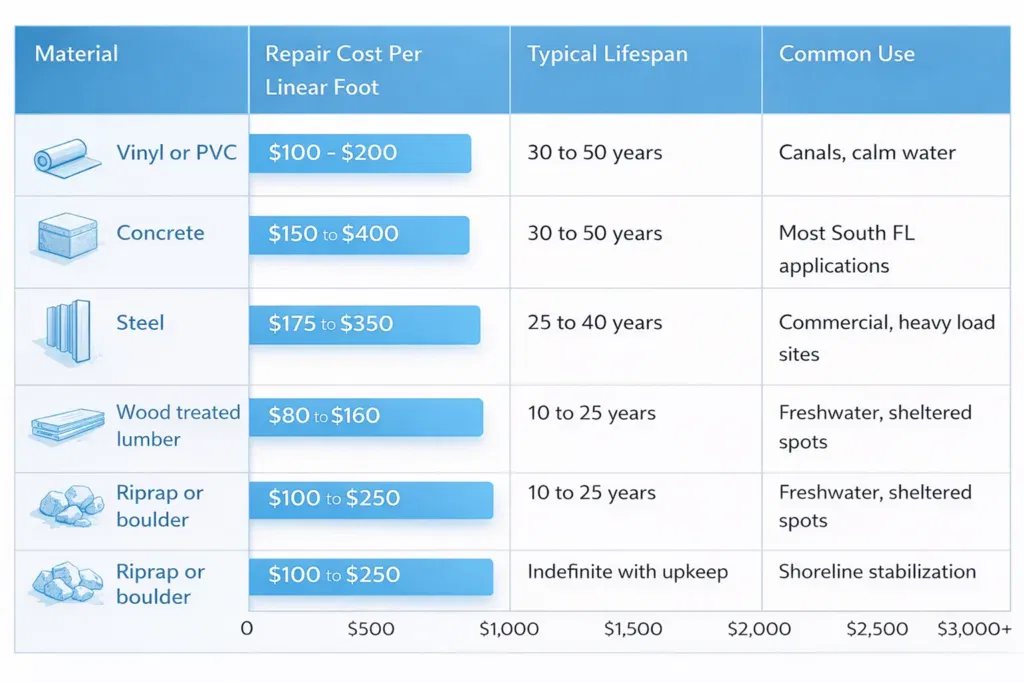
Here is how the common seawall materials typically compare for repair and partial replacement work in South Florida:
| Material | Repair Cost Per Linear Foot | Typical Lifespan | Common Use |
| Vinyl or PVC | $100 to $200 | 30 to 50 years | Canals, calm water |
| Concrete | $150 to $400 | 30 to 50 years | Most South FL applications |
| Steel | $175 to $350 | 25 to 40 years | Commercial, heavy load sites |
| Wood treated lumber | $80 to $160 | 10 to 25 years | Freshwater, sheltered spots |
| Riprap or boulder | $100 to $250 | Indefinite with upkeep | Shoreline stabilization |
Concrete is the material we work with most often in this area. It handles saltwater exposure and storm surge better than most alternatives. The problem is that concrete cracks over time, especially when the rebar beneath the surface corrodes. When rust expands inside the wall, it causes the surrounding concrete to fracture and eventually break apart. Catching that process early makes a real difference to the repair cost.
Vinyl is a popular choice for residential canal walls because it resists corrosion and does not require much maintenance. Steel and aluminum are stronger but need protective coatings in saltwater environments. Without those coatings, salt water attacks them pretty quickly.
Factor 3: What the Soil is Doing Behind and Below the Wall
Soil is probably the factor that surprises property owners most when the invoice comes in. Most people do not think about what is behind and underneath the wall until a contractor starts explaining why there are voids forming back there.
In South Florida, sandy, loosely packed soil is very common behind seawalls. When hydrostatic pressure builds up after heavy rain, that material can work its way through small gaps or erode through failing joints, leaving open voids behind the panels. Once those voids are there, the wall has nothing to lean against and it starts to flex and eventually crack. Filling those voids with expanding grout or polyurethane foam is an added cost, but skipping it almost always means the damage comes back worse.
On the other hand, dense clay or rocky substrate makes driving new pilings or anchor systems a lot harder. That means more equipment time and more labor hours, both of which show up in your estimate.
Watch for these warning signs: depressions or sinkholes forming near the base of the wall, cracks developing in nearby pavement, or visible gaps appearing between the top cap of the seawall and the ground level behind it. Any of these usually means soil movement is already underway.
Factor 4: Environmental Conditions and Local Regulations
South Florida’s coastal environment is hard on seawalls. It is also hard on the contractors fixing them. Tidal windows, seasonal weather patterns, and the permitting requirements tied to waterfront construction all affect how long a project takes and what it ultimately costs.
On the regulatory side, structural seawall work in Florida requires permits in every county we operate in. Miami-Dade, Broward, and Palm Beach all require them. On top of that, many coastal municipalities have their own elevation compliance standards tied to NAVD88, which can require a signed and sealed engineer’s report before the permit office will even look at your application. That report costs money, and it takes time to produce.
Weather matters more than people usually expect. Storm season in South Florida runs from June through November, and an active system can shut down marine work entirely. Jobs that span multiple tide cycles or require low-tide windows can stretch out significantly, and extended schedules mean higher labor costs. It is worth having that conversation with your contractor before work starts, so the timeline is realistic.
Factor 5: How Bad Is the Damage Really
Not all seawall damage costs the same to fix. That sounds obvious, but it is worth stating plainly because the gap between minor and major structural repair costs is enormous.
Hairline cracks caught early. Small joint separations. Surface spalling on the face of concrete panels. These are relatively inexpensive fixes when addressed promptly. The materials are not cheap, but the labor is manageable, and the job moves quickly.
The problem is that small damage rarely stays small. Water infiltrates cracks, finds the rebar, and the corrosion process begins. Over a few seasons, what started as a surface crack becomes a structural fracture. By the time many homeowners actually call us, what could have been a few-thousand-dollar repair has turned into a structural intervention.
Structural repairs are a different category entirely. Replacing failing tiebacks, driving new anchor systems, reinforcing bowing panels, and rebuilding sections from the ground up. These require specialized equipment and considerably more time on-site. Helical pile reinforcement, which is increasingly common for walls with compromised foundations, runs $1,400-2,000 per linear foot in South Florida. That range surprises a lot of people the first time they hear it.
The math on this one is simple. A repair that costs $5,000 to $10,000 today can easily become a $50,000 or more replacement project within a few years if the underlying damage is left to progress. Regular professional inspection is the most cost-effective thing you can do for a seawall you want to keep for the long term.
Factor 6: How Easy Is It to Actually Reach the Wall
Access is something most property owners have not thought about at all when they first call a contractor. It ends up mattering quite a bit.
The best-case scenario for access is a flat open lawn on the land side of the wall where equipment can stage without any obstacles. From there, things can only get more complicated.
If your wall sits behind a pool, tight lot lines, dense landscaping, or a boat lift, the crew has fewer options for getting equipment to the work area. When land access is too restricted, the contractor has to mobilize from the water side using a barge. Barge rental and operation add a meaningful daily cost to any marine job, and it does not show up in a per-linear-foot estimate.
Tree roots, sloped terrain, and proximity to a pool deck or building foundation can all require additional prep work before the actual repair even begins. These are job-specific additions your contractor should identify during the site visit, not surprises that appear on a change order after work has started. A thorough pre-job walkthrough prevents a lot of those conversations.
Factor 7: Permitting in Florida and What It Actually Costs
There is no way around it. Permitted seawall repair work is required in Florida, and the cost and timeline of that process vary more than most people realize.
For a straightforward residential repair, basic permit fees typically cost 2-3% of the cost of the job. But in coastal municipalities with stricter waterfront oversight, and South Florida has plenty of those, you may also need a structural engineering design plan before the permit is issued.
Time is often the bigger issue. Permitting timelines in South Florida can stretch from a few weeks for simple surface repairs to several months for projects in regulated coastal zones. If your wall is actively deteriorating, waiting on a permit while the damage continues to worsen is not a neutral outcome. The wall does not pause while the paperwork moves through the system.
This is one of the real advantages of working with a licensed marine contractor who knows the local system. A team that has pulled permits across Dade, Broward, and Palm Beach before knows what each municipality wants to see and can prepare documentation proactively rather than reactively. That knowledge alone can shave weeks off a project timeline.
Factor 8: The Shoreline Itself and the Type of Water It Faces
Where your seawall sits and what kind of water it is up against matter a great deal both for determining what repairs are needed and how much they cost.
Saltwater environments are harder on seawalls than freshwater ones. Full stop. The chloride content in the ocean and Intracoastal water accelerates corrosion of steel components, breaks down concrete at the surface over time, and causes older vinyl panels to become brittle. Ocean-facing walls on open coastlines take direct wave energy and require more robust construction to begin with, which means more expensive repairs when something goes wrong.
The substrate at the bottom of the waterway matters too. Rocky or hard substrate makes piling installation significantly more equipment-intensive. Sandy loose substrate is easier to work in, but often needs attention paid to scour protection, meaning preventing the bottom material from being pulled away from beneath the wall by current and wave action. Adding erosion control measures during a repair project typically runs $1,500 to $8,000, depending on the scope, but it tends to prevent the kind of foundation erosion that causes much bigger problems later.
| Shoreline Type | Primary Concern | Cost Implication |
| Ocean-facing open coast | Wave energy and salt corrosion | Higher costs, stronger materials needed |
| Intracoastal or bay side | Tidal variation and boat wake | Moderate, standard materials are usually fine |
| Canal or freshwater lake | Lower erosion, less corrosion | Lower costs, more material options |
| Rocky substrate | Difficult piling installation | Higher labor and equipment time |
| Sandy or loose substrate | Scour and erosion behind wall | Potential added cost for erosion control |
What Does a Brand New Seawall Cost to Build?
Sometimes the seawall repair conversation shifts. The wall has failed structurally in too many places, or the cost of repairing it comes close to what a new installation would run, or the original construction was simply not built well enough to be worth patching further. When that happens, full replacement becomes the better financial decision, even if it is a harder one to hear.
New seawall construction in South Florida typically runs $900-$1,500 per linear foot for residential work, depending on materials, height, site conditions, and access. For commercial properties or high erosion coastal zones, the range moves to $1,200-$3,000 per linear foot.
All eight factors we covered above apply equally to new construction. Soil conditions and site access tend to be the biggest variables, and they are the ones most commonly underestimated in early planning.
One thing worth considering if you are replacing rather than repairing the seawall: you get to choose the material and the system going in. Newer seawall designs, including concrete and vinyl hybrid systems and helical anchor reinforcement, offer longer service lives than the older steel or pressure-treated wood installations that were common in South Florida decades ago. Spending a bit more on a better system at the start tends to pay off over the life of the wall.
Frequently Asked Questions About Seawall Repair in Florida
What is the lifespan of a seawall?
Lifespan depends on materials, installation quality, local water conditions, and how consistently the wall has been maintained. As a general guide, concrete and vinyl seawalls typically last 30 to 50 years with proper care. Steel seawalls average 25 to 35 years, potentially longer with protective coatings maintained over time. Wood seawalls in saltwater environments may only last 10 to 15 years. In freshwater protected locations, they can reach 25 to 40 years. Newer composite and hybrid systems are rated for 50 to 75 years by some manufacturers, though those claims depend heavily on installation conditions.
In South Florida’s saltwater environment, plan for the lower end of those ranges unless the wall gets consistent maintenance and regular professional inspection.
How often does a seawall need to be repaired?
Most seawalls enter the phase where active maintenance starts to matter around the 15 to 20 year mark. That does not mean the wall is failing at that point. It means it is old enough that small problems start appearing more regularly and catching them early matters more.
In practice, a well-built, well-maintained wall might need only minor repairs every 5 to 10 years in its early decades, with more significant work as it ages. What we see most commonly in South Florida is deferred maintenance, where owners skip the small fixes for a few seasons and end up dealing with a much larger and more expensive problem down the road. Annual or every other year professional inspection is the single best habit you can build around a seawall you care about.
What are the most common causes of seawall damage?
Based on what we see across seawall repair jobs of South Florida properties, the most frequent causes are:
- Hydrostatic pressure from water buildup behind the wall, especially after heavy rainfall events
- Corrosion of internal steel tiebacks or rebar, which weakens the structure from within, long before surface damage appears
- Soil erosion behind the panels creates voids that allow flexing and cracking over time
- Boat wake, and wave action, particularly along busy canals and Intracoastal stretches
- Root intrusion from trees or large shrubs planted close to the wall
- Poor original installation, including walls that were not embedded deep enough or anchored adequately from the start
Storm surge events accelerate all of these. After a significant hurricane or tropical system passes through, even a wall that looked solid before the storm should be inspected professionally. Damage below the waterline or behind the wall face often does not show up visually for months.
Do seawalls require ongoing maintenance?
They do, and the cost of routine maintenance is almost always a fraction of what deferred maintenance eventually costs. For a typical residential seawall, maintenance involves periodic inspection for cracks or joint separation, keeping weep holes clear so pressure does not build up behind the wall, checking exposed tieback hardware, and sealing surface cracks before water finds its way deeper.
For concrete walls in South Florida’s saltwater environment, professional inspection every one to two years is a reasonable cadence. Underwater inspection is especially valuable because a significant portion of seawall deterioration happens below the waterline where you simply cannot see it from the surface or from a boat.
How deep should a seawall be?
Depth requirements vary by water conditions, local codes, and wall type. As a general reference: walls facing canals or calm water without significant wave action typically require embedment of 3 to 6 feet below the waterline. Walls on open coastal shorelines or areas with meaningful tidal variation generally need to go 8 to 20 feet deep to resist scour and lateral pressure from wave action and storm surge. Your local building code and the engineering assessment required for permitted work are the definitive references here. This is one of the main reasons Florida requires engineering oversight for seawall construction and major repair.
Get an Accurate Estimate for Your Seawall
The most useful number you will get for your seawall repair cost is the one that comes after a qualified marine contractor has actually seen the wall. An experienced eye can identify what type of damage is present, which repairs are structurally necessary versus cosmetic, and whether the wall is a good repair candidate or whether replacement makes better long-term financial sense. The prices listed in this blog are for ballpark estimates and reflect current numbers at the time of this blog posting.
Sea Me Dive provides professional seawall inspections and repair services across Dade, Broward, and Palm Beach County. Our team includes commercial divers who assess damage above and below the waterline, giving you a complete picture of your wall’s condition rather than just what is visible from the surface.
Call us at 754-265-7115 or visit seamedive.net to schedule your inspection.